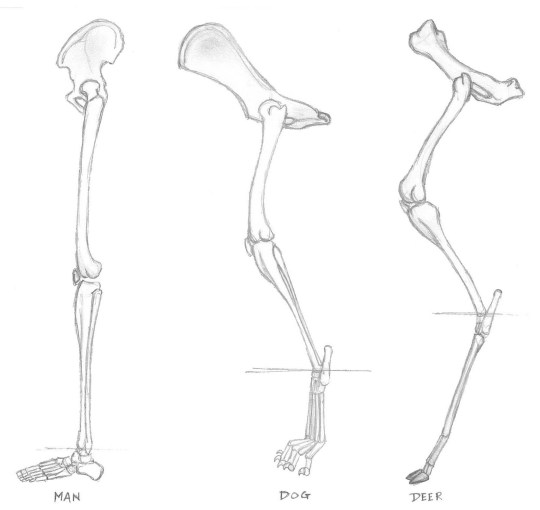
From Latin planta (sole of the foot) + gradi (to walk, to step). Plantigrade animals, which include humans, bears, and raccoons, walk on their phalanges (finger/toe bones), metapodials, and podials (the bones of the wrist/heel & ankle).
Digitigrade
From Latin digitus (finger, toe) + gradi. Digitigrade animals, such as cats, dogs, and birds, walk on multiple phalanges, but not metapodials or podials.
Unguligrade
From Latin ungulua (hoof) + gradi. Unguligrade animals, such as horses and cows, walk only on the distal phalanx.
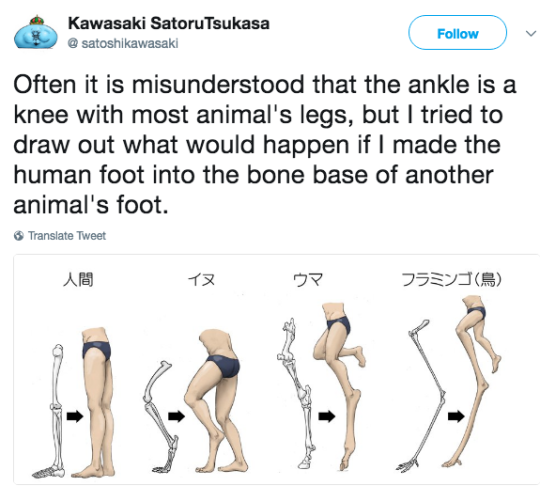
The horizontal lines in the image above show where the ankle is on each diagram. And because this was too perfect to pass up… here’s what a human foot with plantigrade, digitigrade, and unguligrade bone structures with a bonus wading bird foot on the far right (
Okay! I’m going to try to answer this best I can, but before I do, please remember I am just a humble animation student and by no means a professional artist or a seasoned expert, so this might not be the correct way to do things or be extremely accurate. This is just how I do it, and a couple tips I’ve picked up from teachers at school.
First of all, getting familiar with the anatomy of legs helps a lot! (I know this is the dreaded answer to every art question) I don’t know too much about the muscles of the legs other than the basics, so I don’t talk about them here because I don’t want to look like an idiot. They’re very worth studying though, especially the muscles that form the inside of the thigh and back of the calf.
Those are some leg studies I did from life in class last year, with the key parts labelled.
Chances are you’ve tried to draw legs and??
Unless you’re going for a certain style, legs that look like straight tubes or 90 degree angles are gonna look a bit weird.
As you can see with the life drawings above, legs have certain natural curves and rhythms to them! None of the bones in the legs are straight or tubular, so your legs should not be either.
Sorry for the really mediocre pelvis it’s not my strong suit oh god. It’s easy to characterize the legs as something like this:
Remembering that the knee is a hinge joint and that it has a sort of curved offset from the upper leg to the lower leg really helps.
So when you keep that offset in mind and apply some curves over the muscle and fat layered on top of those BEAUTIFULLY RHYTHMIC bones, you get dynamic flow in your legs. The hip (trochanter), kneecap (patella) and ankle (fibula/tibia malleolus) are good landmarks to keep in mind.
So by applying some curves, you get a softer/more dynamic/rhythmic feel to the legs that makes your figure look a lot less static even if they are standing entirely still. It’s also worth noting most people shift their weight onto one hip or another, position their feet weirdly, etc etc.
I want to talk about a comic art convention I see from time to time that really gets up my nose. Now, when I say convention, I mean an accepted technique or practice in the field rather than a gathering of gloriously enthusiastic nerds in costume. In this instance, I am talking about a particular drawing shortcut that is accepted as “solid” and “professional” in the industry that I find teeth-grindingly lazy and bizarre. I call it “Subway Sandwich Thighs”. As illustrated below:
As you can see, the thigh and the calf are sandwiched together, mid-air, without anything pressing against the underside of the calf to make it that way. Legs do not work that way, not even in bendy women. We cannot bend our legs and make them do that in mid-air. For that to happen, we need to put our weight on our bent legs, kneeling on the ground. It is the weight of our bodies that pushes the two parts of the legs together. Usually, the legs splay to the side, so that they aren’t pushed together too hard. We often sit on the side of our butts after about three or four minutes, cause that shit is uncomfortable.
As an experiment, go in front of a mirror, and try to bend your leg as much as you can, pressing your heel to your buttock. Do not use your hands to press the foot and buttock together – just check how close you can get naturally. If you’re a guy, I really want you to try this.
Now, stand there and imagine flying for more than ten minutes in that position. It fucking hurts, doesn’t it? It’s tight, it’s unnatural. It’s the sort of thing a dancer does for two seconds before leaping away into another pose. It is not a natural position to take.
I half-jokingly wonder if artists employ it because it evokes the mental imagery of a woman splaying on top of a man during intercourse, straddling him. It can display the buttocks in a pleasing way, and it also makes much of the crotch. But it’s the most ridiculous bloody drawing convention outside of the Rubber Spine thing, and I’d be more than happy if it died a quiet death.
Here are some gymnasts, naturally flexible people, bending their legs in the middle of routines. Notice their aren’t squishing the two halves of their legs together:
Here are some women kneeling. Just for reference for later corrections:
And now, some corrections:
Okay, enough of me picking on JSC. Here’s the nitty gritty of the matter, and a hat-tip to stylistic choices:
Thanks to tumblr’s downscaling, the red text is: Leg too long, No pelvis all butt, heel goes where? and Where leg go? as well as “This looks odd but my body is really like this”.
The anatomy I’ve done isn’t perfect, but I think I illustrate my point.
The Anatomy of a Fuck Up:
So what’s happening here? Why are people making this mistake over and over? The reason is twofold.
One: Mistaken anatomy.
When these artists draw their stuff to arse-up, face-down, no-time-to-fart deadlines, they don’t have the leisure I do to stop and think about how a woman looks when doing these poses. So when they have to think about a woman flying mid-air, they think about a woman kneeling, rather than an actual woman with her leg in the air. They just transfer the kneeling leg position to the upright position, even though the human muscles, tendons and body mass DO NOT ALLOW for that to happen. With kneeling positions, they just go ahead and trundle out the shortcuts they learnt earlier in the piece, without thought to how heels and butt-cracks work.
Two: It’s Not Important.
In most situations, accuracy of a woman’s anatomy is not important in a comic book or graphic novel. A female character must be alluring above all, so certain anatomically impossible conventions get the wave and are never fixed. Other people learn these “shortcuts” and that it’s okay to draw like that, and it keeps on happening. FOREVER.
I’m not saying don’t use sweeping lines for style. I’m just saying let’s not have utterly ridiculous anatomy going on. These women characters take up so little space already. Draw them as the leg is supposed to look and suddenly they have legs and tendons and physical signs of strength. I guess that isn’t sexy enough?
One of my favourite blogs highlights and explains something about how women are drawn in superhero comics that has bugged me for a while but I couldn’t put it into exact words. Almost all of these pictures have also been on this blog before. Artists do this with a lot of other stuff with women too, such as with breasts, where they create cleavage with clothing or poses where there should be none because their references are from pictures in a different context from what they’re drawing (and they seem to hate having characters wear bras).


 tumblr backup