This is actually really good for babies’ brain development. You’re laying the groundwork for conversation, teaching them through example that people take turns talking and listening.
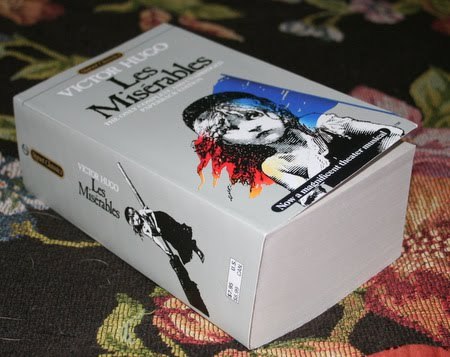
Did you know that babies from affluent families hear an average of thirty MILLION more words before age 5 than babies in families below the poverty line? For context, Les Miserables is about 650,000 words and it looks like this:
So it’s like reading this book 46 times.* And that’s not the total number of spoken words, that’s the GAP between affluent and poor babies. And these are the years in which the brain undergoes the most development. It’s mind-boggling.
So what I’m saying is: keep doing the thing. Do it to all babies, all the time. Narrate your day. Ask them for opinions. (“Should we buy the large bag of potatoes or the small bag?” “Gaabooglagje.” “Yes, just as I thought.”) Point out colors and shapes and letters. Let them scribble outside the lines and treat their babble like talk. Sing them nursery rhymes and Raffi songs and songs from the radio. All of these things are going to build their brains to prepare them for kindergarten and beyond.
*Please do not read Les Mis 46 times to an infant. They don’t even care about the Parisian sewer system.
A small fat bird, like the above, is the hieroglyph used in Ancient Egyptian to mean “wicked” or evil”.
The phrase above him (the inscription should be read from the top down) is “Nb s3″ or “Lord of the son of”. Genitive is usually implied in this sort of phrase without a connecting word, meaning:
This birb has literally created the sentence and declared himself “ Lord of the Son of Evil”
God dammit, I realised I made a mistake doing this from memory- the first sign is “k” for “your”, not “nb” for “lord”. So this birb has declared himself “your evil son”, not “the lord of the son of evil”. Which is not quite as dramatic, but still very menacing. You go bird.
Reblogging this version because I was going “no that’s a cup sign, there’s a handle”.
Sparrow knows what it’s doing I swear, look at its face.
In Spanish it’s machoplantear which is a combination of macho “male” and plantear(se) “to lay out (an idea) / to consider”
We could have had hombrexplicar [hombre “man” + explicar “to explain”] and I’m not sure why we didn’t? Some peopple disagree over which is better.
The noun form is el machoplanteamiento “mansplaining”
My guess is“hombrexplicar” doesn’t capture the critique of “machismo” in quite as pointed a way; that is, “machoplantear” points directly at the problem/the term already generally used to discuss problems of masculinity.
Anyway, I’m delighted by all of this.
You make a very good point
in hebrew it’s הסגברה / hasgvara – basically a mashup of hasbara (explaining, but also carries the implication of ‘propaganda’) and gever = man
I was told recently about a school that was shamed into changing its school motto. The motto was “I hear, I see, I learn.” Nothing wrong with that per se. Unfortunately the motto was in Latin, and the Latin for “I hear, I see, I learn” is “audio, video, disco”.
What the fuck that’s the best school motto ever change it back
Your yearly reminder that “I learn through suffering” can be translated into Latin as “Disco Inferno.”
Meanwhile, “utter” works for the first (e.g., “you utter floorboard”) but somehow “utterly” doesn’t seem to work as well for the second (“I was utterly floorboarded”).
Utterly doesn’t work for drunk because it’s the affix for turning random objects into terms for *shocked*, obviously.
… huh. I thought that might just be the similarity to “floored”, and yet “I was utterly coat hangered” does seem to convey something similar.
I have to tell you, I am utterly sandwiched at this discovery.
Completely makes the phrase mean “super tired”.
“God, it’s been a long week, I am completely coat-hangered.”
since this “latinx or latine” discussion is getting attention again, i’d like to point out that it’s important to know how disabled people feel about it, and why you should consider using “e” instead of “x” for making gendered words neutral.
basically, a blind brazilian and anti-ableism blogger first spoke about this issue in january 2015, claiming that words such as “latinx” and “bonitx” are actually anything but inclusive, since visually impaired people can’t understand what you’re saying, because their reading-out-loud softwares can’t pronounce these words. she then suggests that using “e” as a neutral term can be way more inclusive both to nonbinary and visually impaired people (ex.: latine, bonite). she also states that you can be neutral without using “ela” or “ele” by using instead “a pessoa/that person” or simply using the person’s name.
she stills talks about this issue on her page to this day, as well as many of other anti-ableism activists on facebook, and they ask us to spread the word by sharing their posts – so as a non-disabled person, that’s what i’m doing. i hope this helps!
I just want to add, before anyone asks, that for spanish/portuguese speakers the “x” is really hard to use because %99 of the time it doesn’t come out natural at all. We literally don’t know how to say it, like the softwares. If we use it, it usually interrumps our speech all the time because we have to think how we say it. The “x”/the sound that it makes is not usual in our languages. The “e” not only helps disabled people but also it helps us because its easier and more natural in our tongues.
On top of the aforementioned reasons to shift from latinx to latine for gender neutrality, doing so will not be difficult in oral speech even for native English speakers (instead of saying
/ˈlætɪnɛks/ = Lah-teen-ex
you say
/ˈlætɪnɛ/ = Lah-teen-eh).
If we’re thriving for inclusive language, we should thrive for an inclusive language that effectively includes everyone. The use of Latine (and -e suffixes for gender neutrality in Portuguese and Spanish), unlike that of Latinx (and -x suffixes for gender neutrality in Portuguese and Spanish), does not have ableist consequences, and does not exclude visually impaired people.
-e also seems more natural in those languages to me, since there’s already a number of adjectives such as alegre, triste, verde, etc. that end in -e that are not inflected for gender.
Bugs Bunny accidentally transformed the word nimrod into a synonym for idiot because nobody got a joke where he sarcastically compared Elmer Fudd to the Biblical figure Nimrod, a mighty hunter.


 tumblr backup