First, comics are exhausting. Seriously like, dragging yourself over a bed of nails for 7 years straight exhausting. If you don’t passionately love what your comic is about and/or you don’t have a style that’s manageable and time-efficient, you’ll find it very difficult to produce your comic to completion.
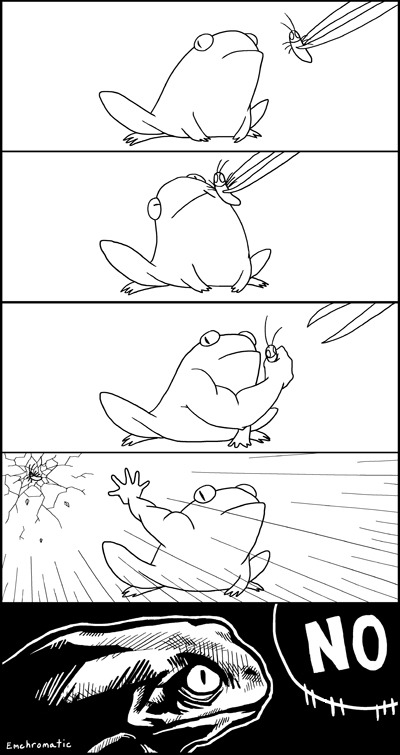
@cooncomic is done in a super simple but efficient style. I use just Indian ink and a quill. I made it as manageable as possible so I wouldn’t grow exhausted with it over time because believe me, I get tired with even the simplest projects after the first 6 months months. SORRY I’M RAMBLING, THE POINT I’M GETTING AT: cut corners at every available opportunity. Find out the quickest, most efficient way to get the final product that you need. Even if that means relying heavily on digital touchups to support your traditional work.
I scan my pages as a .png (retains more data than a jpg) at 800dpi.
Sometimes the panels are ROUGH. Ink sometimes dribbles, it smears. And often I don’t want to wait an hour+ for large ink areas to dry, so I don’t even bother filling large areas in. I just wait to do it digitally.
Could I have gotten the edited version without using digital effects? Yes. But it would have been far more time consuming than was necessary. For me, the key to not getting sick to death of comic-making is to find a way to get a quality product without sacrificing time. But if I did the comic completely digitally, it wouldn’t have the same soul to it. Personally I don’t really enjoy working digitally and it shows–my traditional art has more personality.
After a page is scanned, I play with the tone curve and contrast until it looks how I want, white out the edges of the page so it’s clean, and then I draw on top with white, sometimes dark colours, for touchups. This differs for each page and depends on what you drew the comic in. Ink scans are easier to edit because ink is so harsh and bold, it’s easy to clean up. So here’s an example with pencil:
Jack with the tone curve tool until it looks contrasted enough. (I also white out the borders of the page where the scan gets darker edges)
Then, on a new layer, I draw on top of the page with white, doing touchups and cleaning up details that didn’t scan well. I always use a natural pencil brush so it looks traditional:
There’s no really right or wrong way to clean up traditional scans, just fiddle with it until you get to the product you want.
Traditionally drawn comics are really underrated, I wish there were more. Best of luck with yours!
I don’t use them for @cooncomic because the pages are very short and straightforward with the briefest dialogue. So for the sake of this answer, I’m talking about my more graphic novel style comic work.
Creating the layout of your panels and the composition within them is an art form in itself. It’s storytelling. You’re showing your audience your story. I always think more along the lines of cinematography than illustration for this.
I begin my composition with the last panel in mind. The final panel of your page–that’s your punchline. That’s your climax. It’s not at the middle, it’s at the end. That very last panel is the one I want to leave the viewer focused on. Awed by. Stung by. Melted by. Humored by. Offended by. Whatever the point of your storytelling was. So that’s where I start and where I put the majority of my focus. My final panel is the punchline that everything else will just be leading up to, whether it’s with the dialogue or just the imagery.
Then I have to come up with composition. How many panels do I need leading up to that final panel? How many snapshots will be necessary to set the scene, the setting, the mood? I need to portray these things in the most concise number of panels. So I do a series of thumbnails playing with different numbers of panels, different arrangements of panels, etc. Typically I do this traditionally, on scrap paper. Very quickly. Scribbles, stick figures. I’m just figuring things out. Unfortunately I don’t have many good examples of this to show, because they’re for upcoming projects I’ve yet to announce.
SUPER rough. I do this every time. I never start a serious comic page without testing compositions on thumbnails to help me pick the arrangement that best suits the flow of the storytelling. I need something that will best lead up to that final panel on each page.
Then I pick the thumbnail with the arrangement of panels I like best and redraw that thumbnail digitally, fleshing out the composition in each panel a little better. You can see examples of that in the top left of these pages I’ve done:



 tumblr backup